The Attention Repellent Ads Virus: How to Diagnose It & Avoid B2B Ads That Waste Budget
Disclaimer: If you believe that B2B should be mind-numbingly boring and painful, you will experience extreme discomfort by reading the following article. Continue at your own risk.
Dear CMO, when was the last time you genuinely enjoyed watching a B2B ad? Do you remember any ads from last week? From yesterday? If you do, it’s likely it was a Problemotional Ad — an ad that markets a painful problem in an emotional way. But if you don’t remember them, it’s because they were Attention Repellent Ads. Ads that are mind-numbingly emotionless and shove their service in your face. They get sent straight to Ignoredville. Never consumed. Never remembered. Never influencing buying behavior.
The Human Brain in 2024 Is Suffering from Ad Overload
Ad Overload became a problem back in the 70s, when the godfathers of positioning started evangelizing the phenomenon. But its impact has never been so strong. In 2024, if you use Attention Repellent Ads, you can’t cut past the Ad Overload barrier.
How Do You Diagnose the Attention Repellent Ads Virus?
The Attention Repellent Ads Virus is a Hierarchically Transmitted Disease (HTD). It spreads from the top to bottom — from C-Level to the ones creating the ads. And if you don’t use protection, the whole ad campaign will catch it. Symptoms include: irritated CFO, swelling of ad spend, and in many cases, painful death of marketing budget.
Because it’s hierarchically transmitted, it’s important that you, the CMO, understand the details. If you don’t and you let Simon The Intern decide what ads to make, there’s a 98.7% chance he will recommend using an AR Ad.
An advertisement has 2 components: What is said (The Message) and How it’s said (The Medium).
You can recognize an Attention Repellent Ad when: the message leads with the brand or service, and the medium uses emotionless webinars, ebooks, and stock photos.
You can recognize a Problemotional Ad when: the message leads with the painful problem, and the medium uses emotional videos, gifs, and images.
The former should not be used in Top of Funnel ads. The latter should.
The Message: What AR Ads Get Wrong
AR Ads say “We’re the best” despite everyone else saying the same thing. AR Ads say “Look at my logo 500 times” as if a logo will convince buyers to spend $50k. AR Ads say “Look at my solution” without first addressing the problem. These types of ads are sent to Ignoredville because no one cares about your solution unless they first understand it in relation to the problem. Problems get attention, prioritization, and urgency.
Attention Repelling Message Type 1: Leading With The Brand
“The copy in most corporate advertisements is distinguished by a self-serving, flatulent pomposity which defies reading.”— David Ogilvy
Example #1 — Message: “Look at us! Look at our brand. We’re different.” Viewer Response: “I don’t know you. I don’t care about you. I care about me and my important/urgent problems.” → Ignoredville.

If you have to say you’re different, then it’s probably coming from the subconscious insecurity that you’re actually not. When you market a problem, you’re automatically seen as different. When the rest of the players in your category talk about themselves, be the brand that talks about customers and what they care about — their painful problem. Take a look at the ad copy: is there any company that isn’t committed to “excellence”? If what you say can be said by anyone, it means nothing.
Example #2 — Message: “Here’s our logo. And a generic, vague, and fancy sounding phrase.” Viewer Response: “I don’t know you. This means literally nothing to me.” → Ignoredville.

These kinds of messages make the marketing team feel like a badass. “We’re creating a revolution.” “The new frontier.” “We’re striving for greatness.” But the ad message isn’t supposed to make you feel good — it’s supposed to influence buying behavior and drive revenue. Keep the ego out of it.
Example #3 — Message: Same as above. Viewer Response: Same as above. → Ignoredville.

Attention Repelling Message Type 2: Leading With The Service
“No one buys a solution unless they have a problem.” — Christopher Lochhead
No one buys services. They buy solutions to problems. Your service only becomes a solution in the buyer’s mind when they’re aware of the problem it solves. If your B2B ad campaign uses Top of Funnel ads to make the service the main message, skipping the problem awareness stage, the rest of your funnel will not work. Marketing the problem and owning the problem in the buyer’s mind is the purpose of Top of Funnel ads. Because when you own the problem in the buyer’s mind, you’re perceived as the only obvious solution for it.
Example #1 — Message: “We have solutions.” Viewer Response: “Solutions to what? What problem does it solve?” → Ignoredville.

A common practice in B2B is to list a whole bunch of random services and call them “solutions.” But in the buyer’s mind, this says: “We don’t stand for anything. We don’t really understand your problem. We just really want your money.”
Example #2 — Message: “We do {extremely general category of service}.” Viewer Response: “Why should I care? There are thousands of others that do the same thing.” → Ignoredville.

The Medium: How AR Ads Fail to Communicate
Attention Repelling Medium Type 1: The Webinar
“You cannot bore people into buying your product, you can only interest them into buying it.” — David Ogilvy
If your Top of Funnel Ads send viewers to a webinar, you’re not alone. It seems logical: you get email addresses, you build trust, you show expertise. But this is all based on the assumption that people want to watch your webinar. Have you ever said to yourself: “Aw gee, you know what I could really go for right now? Spending an hour of my precious time listening to a complete stranger talk about something I could have learned from ChatGPT in 2 minutes.” If you haven’t, why do you think others would?
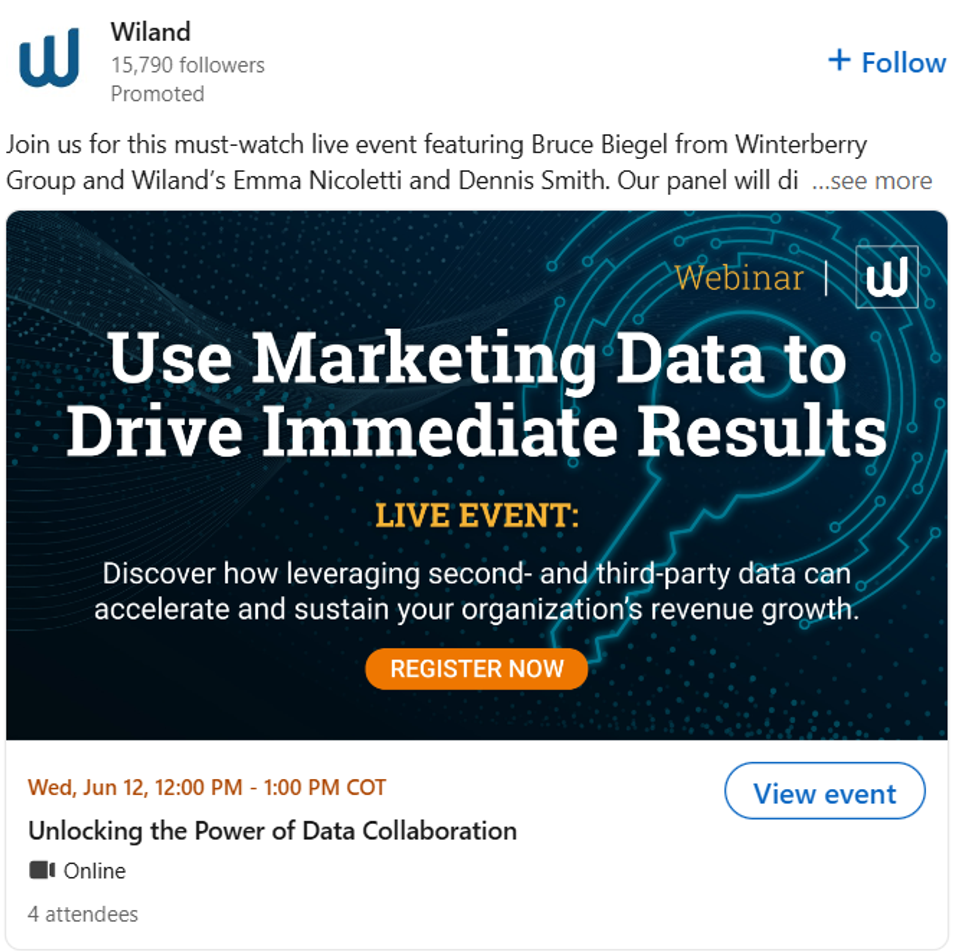
p.s. Who do you think the 4 attendees are? We can take a guess. Rhymes with “the marketing team.”

Attention Repelling Medium Type 2: The eBook
Another commonly used ToF medium is the eBook. It seems logical: give something valuable in exchange for an email and phone number. But few sign up. Andeven fewer actually close. Just like the webinar, most eBooks are both physically and mentally painful to read. Most people know this. And scroll right by.
It doesn’t matter if your eBook is valuable. What matters is if the ad audience will perceive it as valuable. And if it’s the first thing they see from you, they will not perceive it as valuable. If you’ve just met someone, what’s the first thing you would do? Certainly not hand them a book.
Attention Repelling Medium Type 3: The Stock Photos
“Advertising people have an unconscious belief that advertisements have to look like advertisements. They have inherited graphic conventions which telegraph to the reader, ‘This is only an advertisement. Skip it.'” — David Ogilvy
In 2024, where buyers are experiencing extreme Ad Overload, the key is to NOT look like an ad. And yet, so many B2B ads were designed with the sole purpose of looking like an ad. The #1 way to look like an ad is to use stock photos that everyone else uses. When they use stock photos that everyone uses, they look like an ad while also looking like everyone else in the category. Subconscious response: “That is 100% an ad. Zero value for me. Zero difference from any of the other 1000 brands in this category.” → Ignoredville.

The Medicine: Problemotional Ad Examples
If you’ve got the AR Ads Virus, Problemotional Ads are the medicine. Here are three examples:
Problemotional Ad Example #1 — Message (the problem): Website design platforms glitch, stop working for unobvious reasons, and cause extreme frustration. Medium (the emotion): Video that uses relatable and funny metaphors to communicate the message. Viewer Response: “OMG that is exactly how it feels! These guys totally get it. Finally, a website design platform built to solve that problem!” Those are the exact words from a web design agency owner who shared this with us years after having first seen it. Talk about being memorable. → Outcome: perceived and remembered as the Irreplaceable Need-To-Have solution.
Problemotional Ad Example #2 — Message (the problem): Workers waste tons of time and resources on unproductive in-person meetings. Medium (the emotion): Video using relatable and funny antagonist characters to communicate the message. Viewer Response: “Ha! Yes! There’s always that one guy that wants to make a meeting for everything. We’d be so much more productive if we could avoid them.” → Outcome: perceived and remembered as the Irreplaceable Need-To-Have solution.
Problemotional Ad Example #3 — Message (the problem): Taking notes and updating your CRM manually is frustrating and inefficient. Medium (the emotion): Video using relatable and funny victim characters. Viewer Response: “I’ve always felt that way with my CRM! I never knew there was something to solve that problem. I totally need to share this with my coworker — we’ve always complained about that.” → Outcome: perceived and remembered as the Irreplaceable Need-To-Have solution.
By now you should understand the difference in the message and medium between AR Ads and Problemotional Ads. In the next articles, we show you how the difference between AR Ads and Problemotional Ads translates into financial outcomes and ad campaign success.
Frequently Asked Questions
AR Ads (Attention Repellent Ads) is a term for the epidemic of B2B advertising that actively repels viewers. These ads are so forgettable and generic that the human brain automatically filters them out, like a virus spreading across entire industries.
If your ads look like stock footage montages, feature corporate buzzwords, talk primarily about your company rather than your buyer’s problem, or could have been made by any competitor, you likely have AR Ads. The key diagnostic: would your audience stop scrolling?
Problemotional ads combine problem-awareness with emotional resonance. They start by dramatising the specific pain the buyer faces, creating an emotional connection before introducing the solution. This earns attention and builds memory in a way rational feature-lists cannot.
B2B ads typically fail because they skip the step of earning attention. They assume the audience cares about the brand before establishing why they should. In a world where buyers see thousands of ads daily, only ads that trigger genuine emotion or curiosity break through.
The cure is to start with the buyer’s problem, not your solution. Use specific, visceral language that makes buyers feel understood. Invest in distinctive visual and audio choices. Test whether a stranger would stop scrolling, and if not, it needs more work.